Part 5: Revolution
This article is a part of an eleven part series:
- What is this article about
- Early days of the democratic movement
- The kingdom of Pahlavi
Pre-revolution
Revolution 👈
- Reza Pahlavi
- Rajavi and MEK
- Recent political activities
Reformists
- Iran and superpowers
Conclusion
Right after the revolution
As mentioned in the previous part, Emam Khomeini and other clerics could create a robust power chain throughout the whole country just because Shah banned all the independent political parties and organizations, except for his one and only "approved party", Rastakhiz, and the religious ones, mainly because he himself was a religious person. Also, similar to other kings, he claimed that his power came from God. In addition, while Emam Khomeini was in exile, in Paris, he could:
- Convince all the Iranian independent democratic leaders (who had all been suppressed by the Shah) to trust him and believe that he did not seek power for himself,
- With the help of foreign intelligence services, his team could benefit from the knowledge needed to succeed in a revolution. Later, they also used their help to convince the military generals to surrender and join the movement. However, this was not done only by the foreign power, as many military top personnel were already unhappy with the dictator's actions and policies.
After the revolution, many sought power and became potential rivals of the new leader. What happened to them? Many were either eliminated one by one or silenced with life-time imprisonments or executions. Of course, not everyone amongst those was innocent, and some were dangerous armed terrorists killing civilians on the streets to create chaos. (for example, members of MEK, Rajavi's cult, and Kord Separatists)
Some say that the main reason the US embassy in Tehran was attacked in the name of "fighting against imperialism", was the fact that the revolution's leadership was afraid of being exposed, so that people could realize that they were close to or even trained by foreign intelligence services.
Also, Russia could not tolerate a close relationship between Iran and the US, so their assets (for example, Motalefe) supported this attack.
If you think about it, the US and Israel also benefit from that, as they could create this image of a "new Evil" and an "Evil enemy of the world" to justify their future plans for the whole region. A plan that began with the establishment of "Project Israel". Later, with supporting fundamentalists in Iran to misdirect their democratic revolution, and later with 9/11 (which is known to have been done by Israel). And then with "Arab Springs", and all those fundamentalists that they created themselves and supported during the past few decades. Can we prove that? Some yes (they even admitted that), but not everything (yet). Time will (hopefully) show us the truth.
Did they manipulate Shia?
Previously, I mentioned that the original version of Shia was the religion of resistance and fighting against the oppressors, and that's why it is hated by Saudi Arabs and Israelis. To understand this, you should forget about the recent colonial manipulations that external factors have done to Shia, making it extreme for their benefit. Then, we have this new version of Shia that Ayatollah Mesbah founded and then was promoted in Iran after the revolution, which is quite different from what it used to be.
This new version is 100% political and seems to have borrowed a lot from Sikhism, another religion in India, which Brits quite liked it, due to their colonial interests. Ayatollah Mesbah Yazdi was close to Aymadi Nejad, from Jewish heritage, and many think he is a ZiØn1st under a fake mask.
Flag and symbols: After the revolution, the symbols of the Lion and the Sun were replaced. The majority of Iranians didn't want this symbol of the Lion and Sun to remain in the flag because it symbolized monarchy (I will explain it later in the next part)). The person who designed it said that this new emblem can be either read as Allah (the name of God in Islam, which is the same as other religions with one God) or even as an important religious sentence saying: "There is no God but Allah" in Arabic (which is something that the West tried hard to distort by creating all their radical groups. For example, IS1S and T@liban, who were both created by Israel and the US, put that in their flags and emblems, and then began their terrorist activities in the name of Islam to spread Islamophobia and hatred. I guess that this was something planned by the US and Israel to rebrand both Iran and Muslims as dangerous and "enemies of the West", to justify their later inhumane actions.
Apart from what the designer said and what I think, the new emblem of Iran looks very similar to the Sikhism symbol. So, some started to question it ever since:
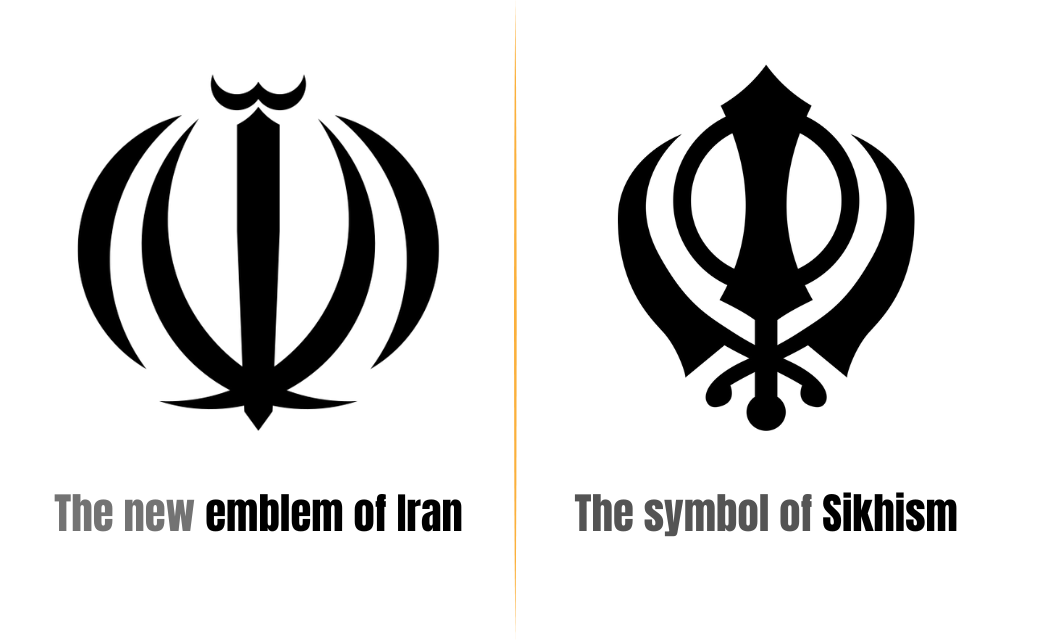
The new Emblem of Iran vs. Sikhism in India
Also, Emam Khomeini comes from a family that migrated to Iran from India. His paternal grandfather, Seyyed Ahmad Musavi Hindi, known as "Hindi" (the Indian), was born in Kintoor, a small town near Lucknow, The capital of Awadh (Oudh) in India. This also adds to the suspicion. Is it true? I don't know.
Religious turban:
As shown in the picture below, the newly used religious turban which is worn by Shia clerics is very similar to what Sikh leaders wear.
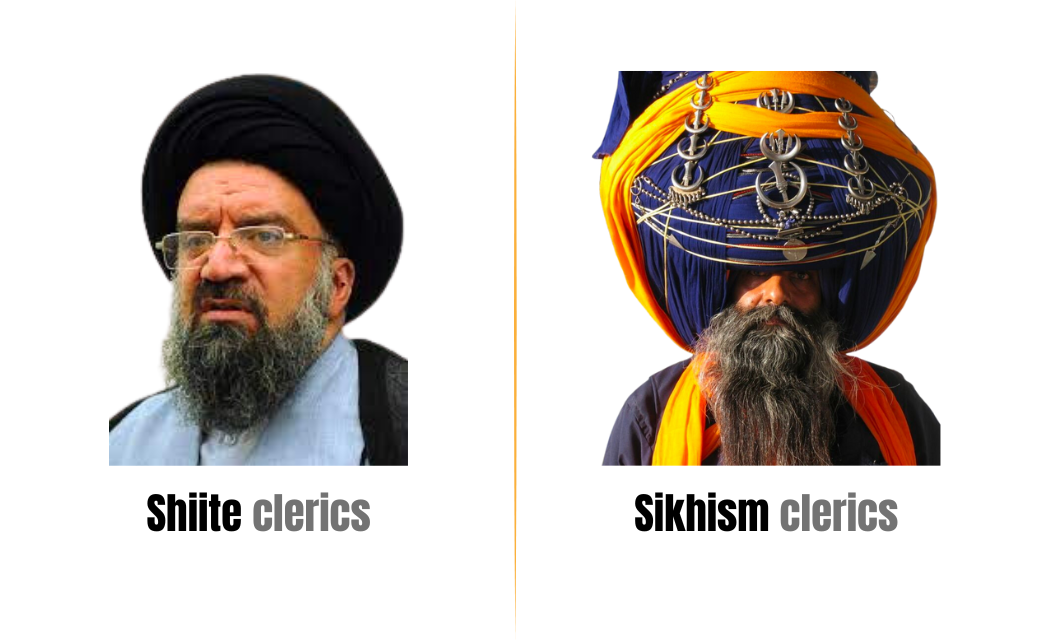
Shia Mullahs vs. Sikhism leaders
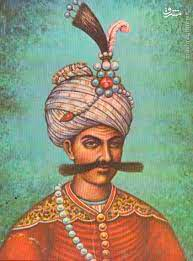
During the Safavid (Safavi) dynasty, which facilitated the move of some wealthy families from Lebanon and created the initial version of a new political/ruling version of Shia (a bit different from what Emam Khomeini brought), this a kind of turban was also used by the kings. Of course, with a lot of jewels and marbles on them. For example, this is a photo of Shah Abbas Safavi, the 5th king of the Safavi dynasty:
The war with Iraq
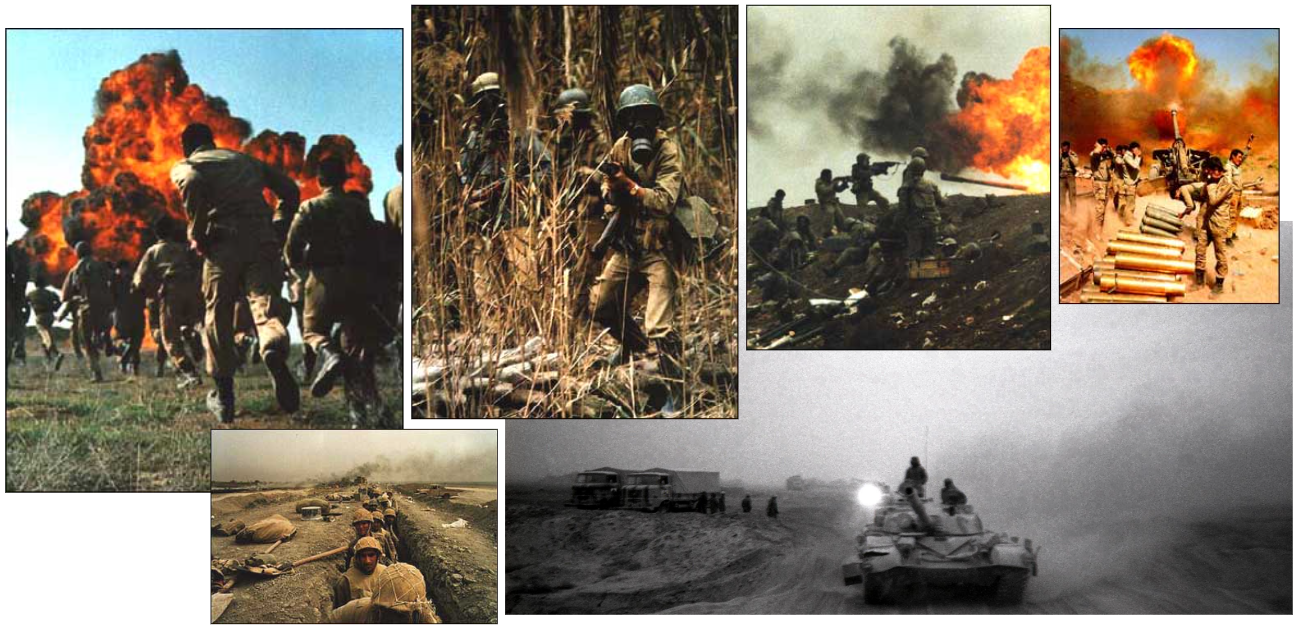
This could be the ideal time for Iran to recover from the revolution and for the democratic movement to regain its footing. However, when Saddam Hussein attacked Iran, it became an excellent opportunity for the radicals to strengthen their power by sneaking into the new wing of the military. A wing that was supposed to be filled by people who cared about their victory in overthrowing the last king and loved their country. The ones who wanted to protect it from foreign invaders, and joined Sepah to fight against Iraq and the Western colonial powers who were supporting Saddam Hussein.
The war between Iran and Iraq
Even though these radical groups could enter this new military branch, and later some became commanders, unlike what the US, UK, and Israel falsely claim, not everyone in that organization is a fundamentalist. Sepah is an official branch of the Iranian military, and like every military, it includes good and bad. Their foreign branch has fought against IS1S and other Western-backed extremists in the region and has protected Iran for many years.
Remember that it was the United States that was providing Iraq and Saddam Hussein with AWACS airborne early warning and control (AEW&C) systems, France with Exocet missiles and Mirage fighters, and Germany was supplying Iraq with chemical weapons! Chemical weapons that were used to kill innocent Iranian Kurds, Lors, Persians, etc.
Yes, your politicians in the West supported Saddam Hussein and his illegal invasion! This is the kind of double standard we are talking about, and the various crimes that Western countries have committed against the Iranian people and humanity. And that's why Iran cannot easily trust the West.
Right after the death of Emam Khomeini
Right after the death of Emam Khomeini, a group of radical Islamists wanted to promote their option, Ayatollah Mesbah Yazdi, to become the new leader. This terrified Ali Khamenei and Hashemi Rafsanjani, who were two of the closest ones to Emam Khomeini. That might be the reason why Hashemi Rafsanjani supported Ayatollah Khamenei to become the next leader. People believe that Mr. Khamenei had already promised Hashemi Rafsanjani to stay in power next to him. Is that true? I don't know.
Later, together, they changed the constitution and made the leader the chief of the army. They also silently changed the type of system from a constitutional theocracy to an absolute theoretical monarchy, where the leader now has absolute power over almost everything.
During this time, Emam Khomeini's son, Ahmad, mysteriously died, and many believe that he was killed by the order of someone who sought power and saw him as a threat. Also, Ayatollah Montazeri, who was chosen by Emam Khomeini as the main candidate to become the next leader, was put under a "house arrest" and was not even allowed to communicate with the outside world until he died. Some say that this way, the new leader could strengthen his power and worry less about potential competitors. Is that true? Again, I don't know.
Thank you for reading this far. Next part?
Part 6: Reza Pahlavi