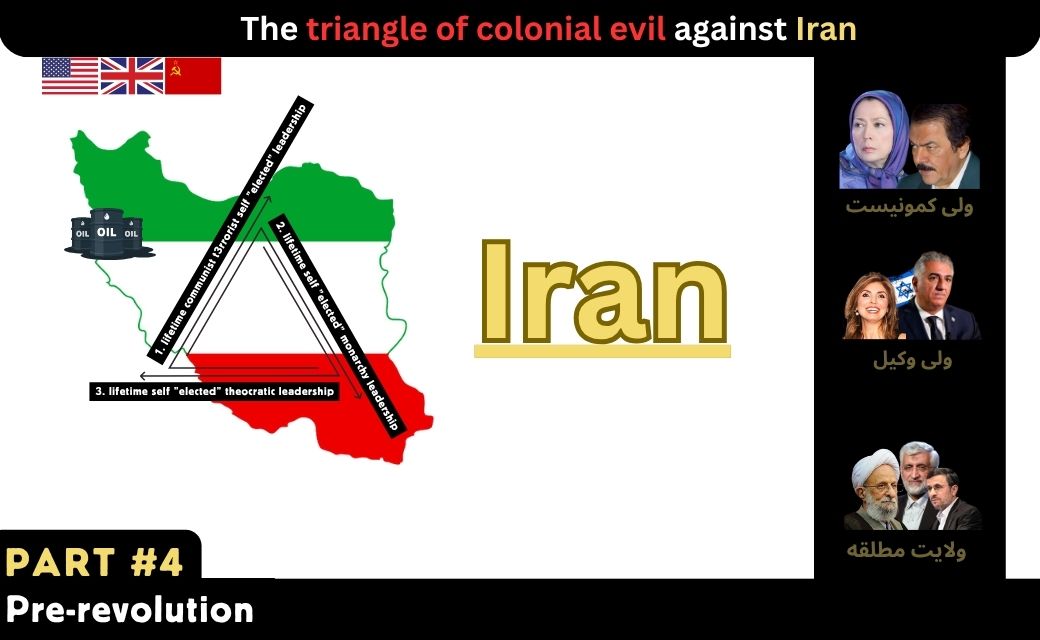
Part 4: Pre-revolution
This article is a part of an eleven part series:
- What is this article about
- Early days of the democratic movement
- The kingdom of Pahlavi
Pre-revolution 👈
Revolution
- Reza Pahlavi
- Rajavi and MEK
- Recent political activities
Reformists
- Iran and superpowers
Conclusion
The democratic movement: Pre-revolution
After World War II, Mohammad Reza Pahlavi invested heavily in Iran's technology, industry, military, and modernization. He also established several universities and sent numerous Iranians to study abroad. But he had closed his eyes to the fact that a highly-educated society would not bend to a dictatorship and would not accept the existence of a king or the concept of one-and-only political party (Rastakhiz party—supporters of the monarch). He also sought to weaken the constitution to establish himself as an absolute monarch.
During this time, people were fighting back and sought a democracy similar to that found in countries like the US.
So far, I have spoken with many Iranians from that time, asking them why they replaced a lifetime king with another lifetime leader with just a different name? Emam Khomeini was a charismatic person who was against the dictator, and we trusted him mainly because he was an old man of God. Also, the majority of people didn't know him well until the last years of the revolution, when the BBC radio began promoting him while he was living near Paris. (similar to how these days BBC, ManotoTV, and the Israeli-funded Iran International channel all together promote Reza Pahlavi's dictatorship)
After establishing OPEC to control oil prices and a few years before the West overthrew him, Shah had a few interesting interviews with American, British, and Canadian journalists. For example, you can watch his interview in 1974 with Mike Wallace an American journalist.
Why Emam Khomeini?
When Shah (the last king) was in power, he did not allow any political parties to be formed, and the only allowed political party in his dictatorship was the Rastakhiz, which was mainly the apple polishers of the king.
Shah was a religious person, similar to all other kings worldwide, who gained the legitimacy of their power from religion. That's why Rohaniun were the only ones allowed to operate freely. They used that exclusive freedom to build a network of mosques and to make an organized gang. Later, they used that network to overthrow the king.
As no other parties were allowed to form, the only way to fight back was to utilize the religious network. So, all the democratic leaders gathered behind this charismatic person, Emam Khomeini, trusting him to lead the movement and later to give the power to the people. Similarly, nowadays, Reza Pahlavi is asking others to trust him fully, and to believe that he wants to "bring democracy" by establishing an absolute monarchy!!! He wants people to believe this traitor while he has betrayed his own country by allying with the worst enemies of Iran, such as Israel and the US. The Israeli terrorists who are now killing Iranian civilians in 2025, attacking hospitals, and infrastructure.
Quick note: even though many things didn't go well after the revolution, mainly because of the war with Iraq that empowered a group of extremists in the system, I think Emam Khomeini was still quite popular. That's why when he died, more than a million people attended his funeral! I remember my mom's tears when she was watching his funeral... Even to this date, many still respect him more than anyone else, because he could help Iranians get rid of the Pahlavi's dictatorship.
Emam Khomeini had a charismatic personality and could influence the crowd to follow him in any direction! He could even make them cry or laugh in a few seconds! I remember that when I was a kid, watching him on TV with my mom.
What happened to the leaders of democratic parties
During the past four decades, I have spoken with many people from the previous generation with different ranks who were involved in the revolution. Almost everyone was telling me that nearly no one knew Emam Khomeini well enough, until the last year of the revolution. The majority of people thought he was just a "nice old guy" who represented religions similar to the pope and other priests and probably was not interested in power. No one knew that he wanted to establish a religious-based governmental system. Even the term "Islamic Republic" was quite vague for most people as they thought it simply means a kind of republic that kinda respects our religion, Shia; Nothing more.
Based on my talks with these people, I think political parties also thought they could use religious influence to convince more people to join and operate under this exclusive freedom that the king had given to the religious leaders.
Did the West train Emam Khomeini?
While Emam Khomeini was in exile near Paris, he and his top aids were in contact with the CIA and MI6, presenting and sharing ideas with them on how to overthrow the Shah. For example, people like Sadegh Ghotbzadeh and Mehdi Bazargan were being advised to convince the army and politicians close to the throne to join the revolution.
During this time, BBC Farsi primarily promoted him as the "one and only" leader Iran should have. One of Emam Khomeini's most famous interviews were conducted by the BBC, and some consider that it has played a significant role in the 1979 revolution.
I'm not sure about this claim, but some say Emam Khomeini, or at least people who were close to him, was trained by foreign intelligence services, when he resided in a village near Paris for a few years. These people say they trained him, similar to Jolani, an ISIS/Al-Qaeda leader who was trained by the CIA and Mossad, and then later took over Syria in 2025.
Contrary to that claim, some think Emam Khomein was wise enough to fool the foreign intelligence services, by giving them false promises and then using their power to overthrow the Shah and free Iranians from that dictator. These people say that's why Emam Khomeini later said "Khod'e kardam" meaning that he had to say white lies.
Which one is true? I don't know.
Finally, one week before Shah (Mohammad Reza Pahlavi) left Iran, General William H. Sullivan flew to Iran, directly spoke with Iranian top generals (without Shah knowing it, as he was just a weak puppet) and told them to accept Emam Khomeini and advised Shah to leave Iran as soon as possible. Emam Khomeini and the US apparently have previously agreed upon this through negotiations with Mehdi Bazargan. You can read more about it here.
Below is a video of Mehdi Bazargan (in Farsi) explaining how Emam Khomeini could convince the US to tell the king to leave Iran. Bazargan was one of the naive democratic leaders who thought Emam Khomeini was just an old nice religious man who was not interested in power. Later, Bazargan became the head of the provisional government and resigned after the US embassy was taken over with the leader's approval.
Your browser does not support the video tag.
Thank you for reading this far. Next part?
Part 5: Revolution