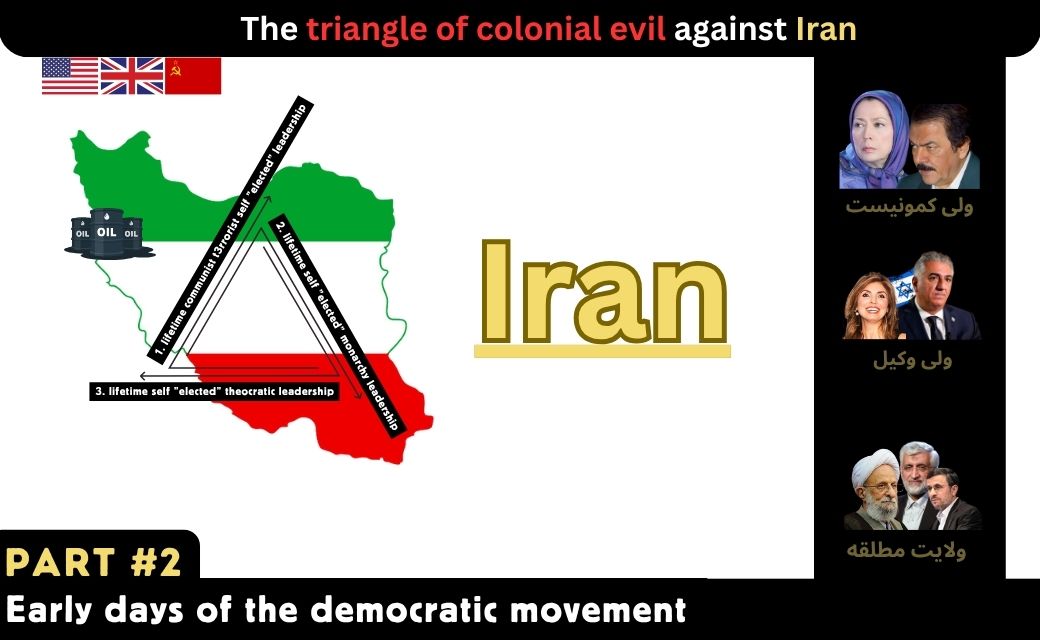
Part 2: Early days of the democratic movement
This article is a part of an eleven-part series:
- What is this article about
- Early days of the democratic movement 👈
- The kingdom of Pahlavi
Pre-revolution
Revolution
- Reza Pahlavi
- Rajavi and MEK
- Recent political activities
Reformists
- Iran and superpowers
Conclusion
Before the democratic movement: Weaknesses of the Qajar dynasty
The Qajar dynasty was established following the defeat of the Zand dynasty and the capture of Tehran in 1785. In 1796, the new king officially declared himself a Shah (Shah means King in Persian).
The Qajar dynasty was not powerful enough to resist the rising competitors and big powers in the region. So, after a few wars with Russia and Britain, it had to accept the terms of the treaties that did not favor Iran.
For example, in 1813, Iran and Russia signed the Treaty of Golestan, which resulted in Iran losing control over parts of the Caucasus region. In 1828, Iran and Russia signed the Treaty of Turkamanchay, which resulted in Iran losing control over the rest of the Caucasus region.
In 1856, Britain invaded southern Iran to protect its interests in the Persian Gulf. After a year, in 1857, the Treaty of Paris was signed between Iran and Britain, which required Iran to withdraw from Harat (now in Afghanistan). Afghanistan used to be a semi-modern country when it was controlled by Iran, and even up until a bit while before the US/UK/Israel created Al-Qaeda and Taliban for them and replaced their modern government with terrorists!
During that time, the kings relied heavily on loans from European powers, which led to the granting of economic concessions not only to foreign governments but also to individuals!
For example, in 1872, Baron de Reuter privately bought the rights to Iran's banks, currency, transportation infrastructure, and communication industries (including the telegraph system).
In 1891, the king granted a 50-year concession on tobacco to a British company, which led to a boycott of tobacco by Iranians.
In 1901, the king granted a 60-year oil concession to William Knox D'Arcy, which led to the formation of the Anglo-Persian Oil Company, later rebranded to British Petroleum (BP).
The democratic movement: Ghajar
People were unhappy about giving away their country and wealth to Russia and Britain! So, the democratic movement in Iran began with the Constitutional Revolution during the Qajar dynasty.
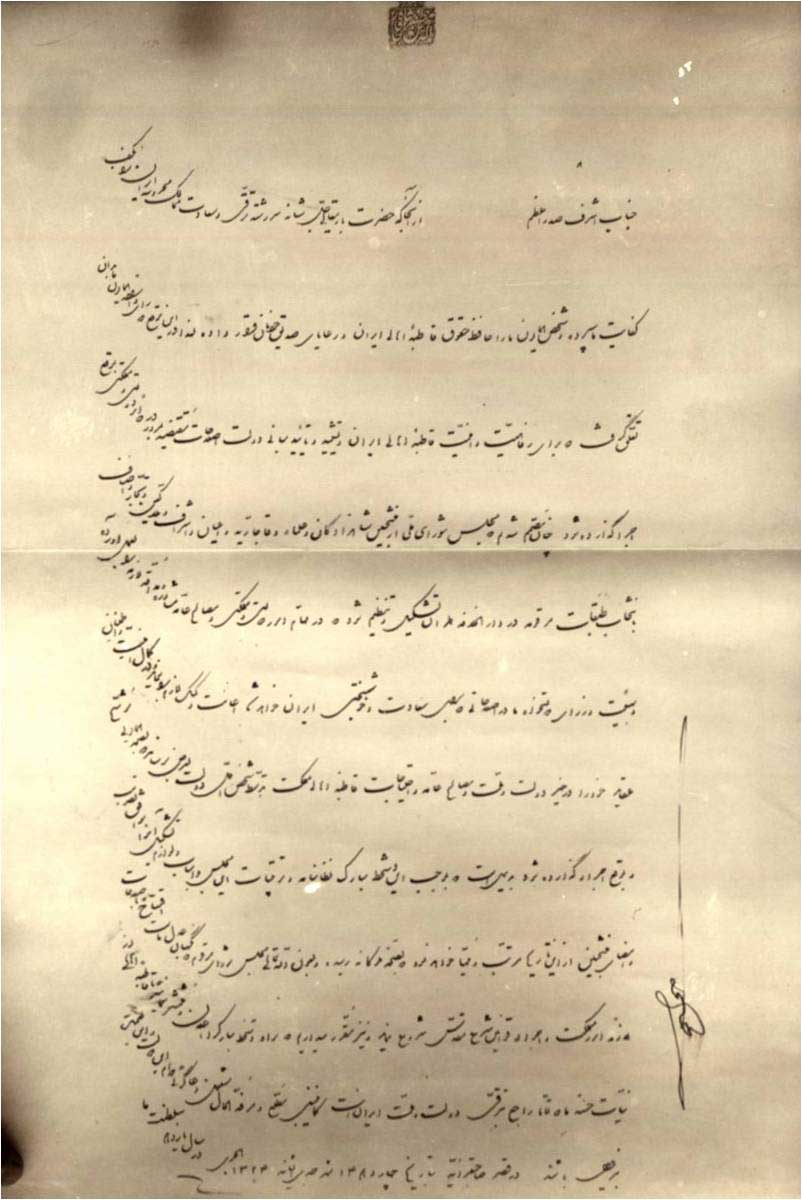
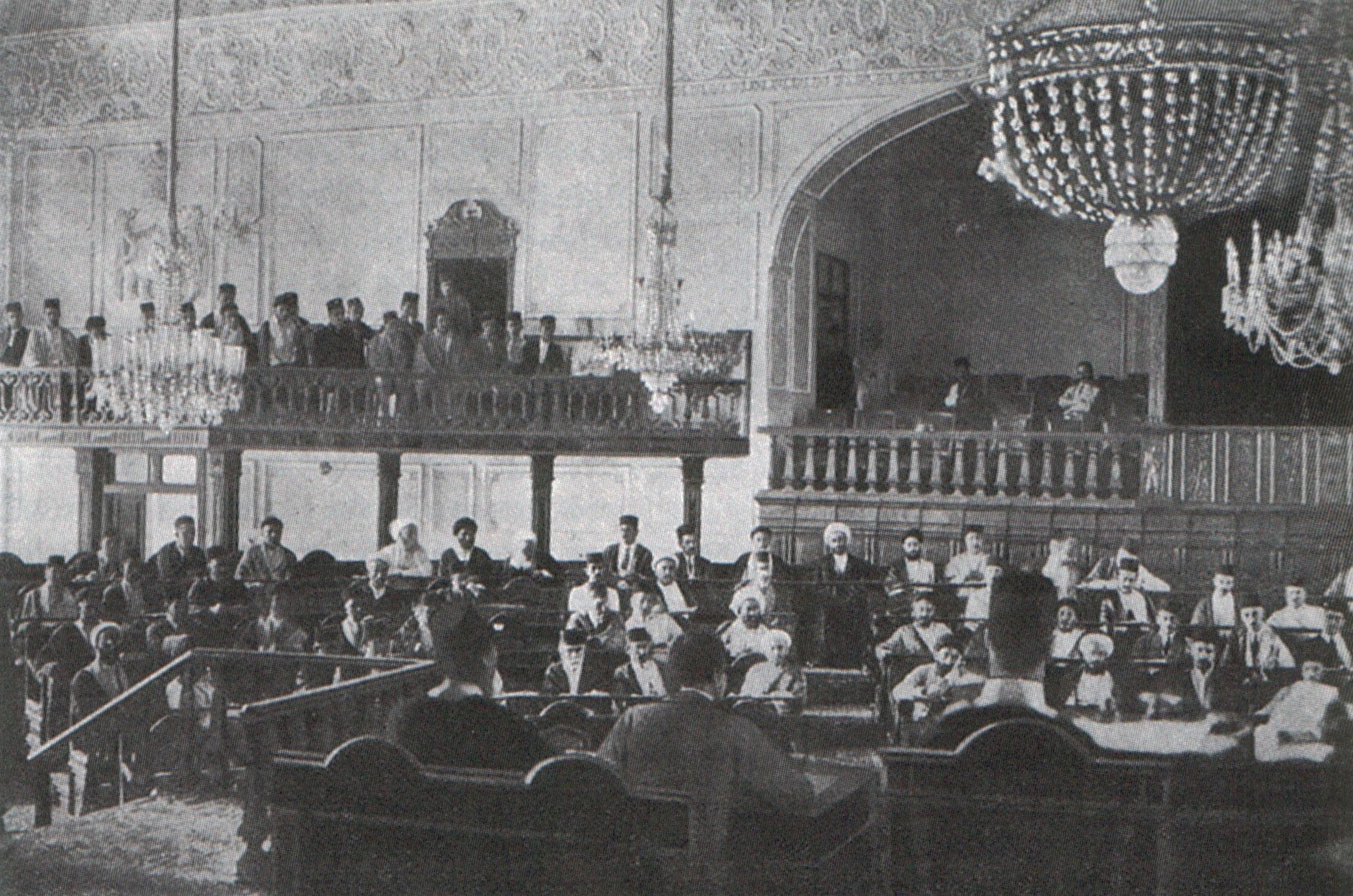
On August 5, 1906, Mozafar e-Din Shah of Qajar was forced to issue the constitution decree and create an elected parliament. During this time, the first constitution was written to limit the royal power, and a parliamentary system was established.
Below is a photo of Mozaffar e-Din Shah Qajar's Royal Proclamation, which established the constitutional monarchy on August 5, 1906, and accepted that parliament would limit his power.
And this is a photo of the first Iranian parliament in 1906.
Throughout the 19th century, Iran became a battleground for influence between Russia and Britain, known as "The Great Game". These powers sought to control Iran due to its strategic location between the colonized British India and Russian Central Asia around Afghanistan and China.
The Qajar dynasty was not powerful enough to fight against these new large empires, and they were unhappy about the new democratic movement. So, in 1907, they compelled the new young king to accept the Anglo-Russian Convention. As a result, Iran was divided into three zones: the Russian zone, the British zone, and the neutral zone. You can read more about it here.
During this time, both Russia and Britain studied Iranian society to evaluate how they could influence and control it.
The British were primarily interested in the oil fields in southern Iran. Based on a lease obtained in 1909, the Anglo-Persian Oil Company (later BP) constructed the Abadan Refinery, which was completed in 1912 as a pipeline terminus and one of the world's largest oil refineries at the time. You can read more about it here.
Brits showed interest in Shia - a personal story
I had a grandfather (from the father's side) who died in the year 2000 while he was 103 years, 3 months, and 3 days old! (I remember this because I was there where they were calculating his age before burial) That means he had witnessed Iran during the periods of World War I, World War II, the Qajar, Pahlavi, and post-revolution eras.
When he was still alive, whenever we visited him, he would tell us stories about the past. Once, he told me that when he was young, he wanted to study at a School (back then, we mostly had these "everything schools" focused mainly on religion and run by clerics). He wanted to become a Molla (a Shia cleric), primarily because he was a Seyed (a descendant of the Prophet) and one of his great-grandparents had migrated to Iran from Lebanon. Then, after a couple of years, he met a few Brits who had studied Farsi, moved to Iran, and enrolled at the same school to study more about this religion. He said, out of curiosity, he used to speak with them to understand their primary interest in this religion.
Interestingly, as he said, one of them once told him that they were interested in this religion because they could see some similarities between this kind of Islam and Sikhism in their colonized India. My grandfather said that back then, our Shia clerics used to wear a different type of clothing. Shia is what our ancestors in Iran founded for good, to kick out aggressors, which is something that colonialism doesn't like. While exploring the power of this type of Islam, Shia, they sought locals willing to collaborate with them. These British individuals offered my grandfather the opportunity to collaborate with them, but he refused. He suspected something shady was happening, so he reported it to the school's administrators. However, no one was willing to take action, so he left.
What is Shia?
In short, 14 centuries ago, Iran was invaded by Arabs who live in what is calleed Saudi Arabia today. This happened because back then, the Sassanian Empire was weakened after a few wars with the Byzantine Empire (Eastern Roman Empire, and what is called Turkey today). People were not happy with Zarathustra's new generation of corrupted clerics. Then, people who lived in our Western borders (today's Lebanon, Syria, Iraq, Kurdish parts of Iran, etc.) fell into the trap of "equality" and "a bright future" lies in the promise that this new religion was promising. Arabs won the war, killed the king, enslaved the queen, and took over the majority of the land. Everywhere, except the Northern parts, due to the mountains and the cold weather. After that, they beheaded thousands of powerful men and enslaved beautiful Iranian women for almost two centuries. We call that the dark era: two Centuries of Silence.
Meanwhile, our ancestors founded Shia Islam, which is a combination of the original Islam and the local beliefs. Shia was founded based on the idea that the Prophet's family (Ahle Beyt) should lead the Muslim community, and the primary purpose of it was to fight back against the foreign invaders. For example, in Shia Islam, we have the concept of the Mahdi, which is a version of the Messiah, originating from pre-invasion stories. A story that also found its way into the neighboring religions, including Judaism and other Iranian-based religions, such as Zoroastrianism, which was the newer religion in Iran after Mithraism. Mithraism was introduced to the Romans and later incorporated into their modern version of Christianity.
That's why Shia is the religion of resistance and fighting against the oppressors. That's why it has been manipulated recently by the external factor of colonialism to make it extreme. And that's why Saudi Arabs, Brits, Americans, and Israelis hate it so much. With the new manipulations done by the Brits, the US, and Western allies, Shia became a bit extreme. And with the latest generation of corrupt clerics who have stolen millions of dollars from the people, many Iranians are now unhappy with their religion. A religion that was once founded to save Iran is now being manipulated enough to weaken it. The original form is still thought of by philosophers like Dr. Elahi Ghomshei. You can listen to some of his lectures here.
Thank you for reading this far. Next part?
Part 3: The kingdom of Pahlavi